
THE PRICE OF PROGRESS: ARTIFICIAL INTELLIGENCE, HIDDEN LABOUR, AND HUMAN RIGHTS IN THE GLOBAL SOUTH
Every time you use AI, someone, somewhere, is being broken by it. The question is not whether you benefit from artificial intelligence. The question is: at whose cost?
I. INTRODUCTION
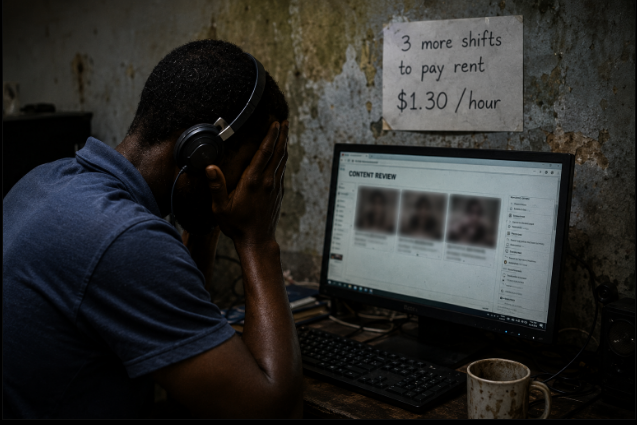
We celebrate artificial intelligence as the defining achievement of our era. Governments hold summits. Corporations announce breakthroughs, and billions are poured into the AI industry each year. But behind every AI chatbot, every content filter, and every “safe” social media feed exists an invisible workforce who are mostly women, mostly poor, and mostly from the Global South. They spend their days watching rape videos, child sexual abuse material, and extreme pornography so that the rest of the world never has to.
They are paid as little as $2 an hour. They are silenced by non-disclosure agreements. When their minds collapse, they are dismissed. And the trillion-dollar companies that profit from their labour are, by legal structure, not considered their employers.
Artificial intelligence, labour exploitation, economic vulnerability, and human rights violations are not separate issues. In fact, they are one system, and the women of the Global South sit at its most brutal intersection.
II. THE HIDDEN WORKFORCE: WHO THEY ARE AND WHAT THEY ARE FORCED TO DO
Before an AI model reaches the public, it must be taught to recognise harmful content. This process is called Reinforcement Learning from Human Feedback (RLHF) and is not performed by a machine. It is performed by a human being who is required to watch, label, and categorise the worst material on the internet: pornography, rape footage, child sexual abuse material, and beheadings.
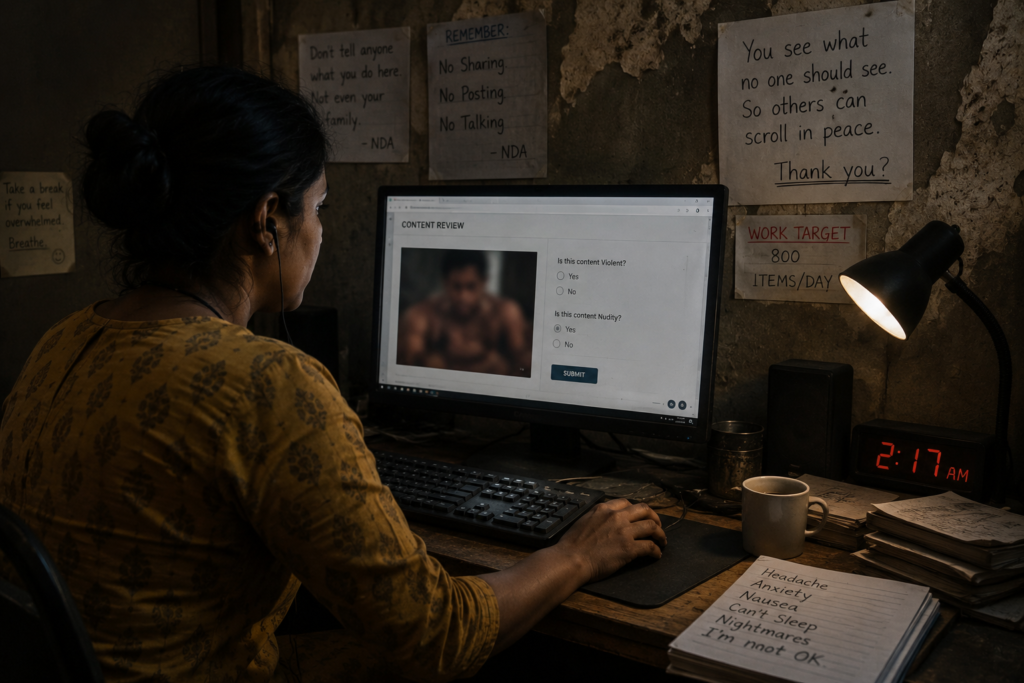
Workers are rarely told this at the point of hiring. They apply for “data annotation” roles, are recruited through outsourcing firms such as Samasource, Teleperformance, or Majorel, and within weeks find themselves reviewing up to 800 graphic items per day.
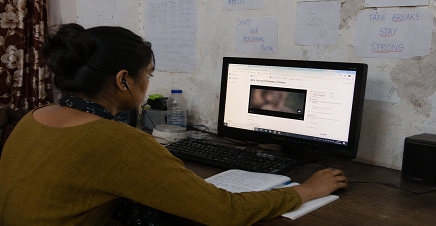
In Jharkhand, India, a 26-year-old, working from a mud-walled veranda, speeds up a video of a woman being assaulted. Her job requires her to watch until it ends.
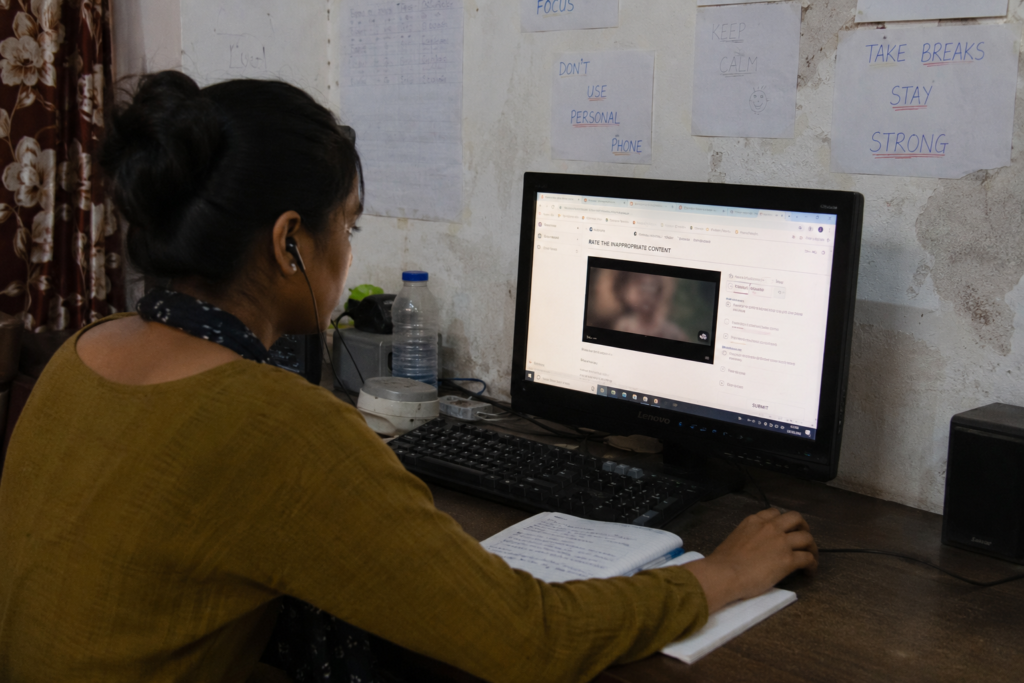
In Ghana, a moderator identified only as “Solomon” attempted suicide after months of reviewing extreme content for Meta’s pipeline. He was subsequently terminated.
In Lagos, a TikTok moderator died after colleagues described repeated complaints about an unbearable workload going unaddressed by management.
These are not isolated incidents. They are the operating model.
III. THE GLOBAL SOUTH, WOMEN, AND THE ECONOMICS OF EXPLOITATION
The geography and gender of this crisis are not coincidental. Big Tech deliberately outsources content moderation to countries where wages are lowest and labour protections are weakest—countries like India, Kenya, Ghana, the Philippines, and Colombia.
Nearly 80% of India’s estimated 70,000 data annotation workers come from rural areas, while the majority are women entering paid employment for the first time who are unaware of their labour rights and fair working conditions.
This is not empowerment. It is targeting.
Content moderation has been deliberately feminised and marketed as “flexible, home-compatible, skill-based” work precisely because patience, emotional labour, and domestic flexibility are qualities that society already demands from women without compensation.
Men occupy the high-paid roles in AI—software development, system architecture, and management.
When the choice is between starvation and watching rape footage for $2 an hour, that is not a choice. It is coercion.
Unemployment, familial pressure, and the complete absence of alternatives make refusal functionally impossible. The industry profits precisely because these women cannot say no.
IV. LEGAL SUPPRESSION: NDAs, OUTSOURCING, AND THE ACCOUNTABILITY VOID
Workers in this industry sign non-disclosure agreements of extraordinary breadth, prohibiting disclosure of their work not only to journalists but also to family members, doctors, and lawyers.
Equidem’s landmark 2024 investigation, Scroll. Click. Suffer., found that 68 of 110 Kenyan moderators declined to be interviewed, the majority citing NDA-related fear of termination.
NDAs of this scope likely violate Article 7 of the International Covenant on Economic, Social and Cultural Rights (ICESCR), which guarantees safe and healthy working conditions, because they prevent workers from accessing occupational health support.
Compounding this, no major AI company directly employs its moderators.
When 140 Kenyan moderators diagnosed with PTSD sued Meta and Samasource, Meta denied being their employer. The Nairobi Employment and Labour Relations Court ruled otherwise, and Meta appealed. Hence, no compensation has been paid as of 2026.
Meta subsequently relocated its African moderation operation to Ghana, where a 2025 Bureau of Investigative Journalism investigation found working conditions to be materially worse.
When accountability threatens, the operation simply moves.
The system is designed to ensure that justice never arrives.
V. HOW ARTIFICIAL INTELLIGENCE VIOLATES HUMAN RIGHTS
The human cost is no longer a matter of allegation; it is a clinical record.
Dr. Ian Kanyanya of Kenyatta National Hospital found that 81% of assessed Facebook moderators in Kenya met the diagnostic criteria for PTSD, anxiety, or depression.
Equidem’s 2025 survey of just 76 workers across four countries documented 60 independent incidents of serious psychological harm, including suicidal ideation, dissociation, substance dependence, and panic disorder.
Sociologist Milagros Miceli has stated that she has yet to encounter a single moderator who escapes harm.
At its core, this is not a labour dispute. It is a human rights violation.
When a corporation compels a person to destroy her mental health for survival wages, it violates Article 23 of the Universal Declaration of Human Rights, which guarantees dignified conditions of work.
When it denies her a safe workplace, it violates Article 7 of the ICESCR.
When it erases its own liability through subcontracting chains while continuing to profit, it violates the UN Guiding Principles on Business and Human Rights, which require corporations to identify and prevent harm across their entire supply chain, regardless of how many contractors stand between the boardroom and the broken worker.
International law is unambiguous.
The industry’s compliance is non-existent.
VI. DO WE STOP TO THINK? A CALL TO CONSCIENCE AND REFORM
The next time you open Instagram, ask a chatbot a question, or scroll through a curated feed, pause and ask:
Who made this safe for me?
The answer is a woman in Jharkhand, Nairobi, or Accra, watching content no human being should be required to see, earning less than the cost of your morning coffee, bound by a contract that prevents her from telling even her own family what her job demands of her.
We celebrate AI’s progress as though it were free.
It is not.
It is paid for in the mental health, dignity, and rights of the world’s most marginalised women.
We are living through a profound technological transformation and, simultaneously, through a labour rights crisis concentrated among the poorest women on earth—hidden by legal architecture and geographic distance, and largely ignored by the societies that benefit from it most.
Reform must be structural.
The NDAs that obstruct occupational health rights must be prohibited.
Primary employer liability must attach to AI platforms regardless of subcontracting structures.
Content moderation must be formally classified as hazardous work.
The question is not whether AI will transform our world—it already has.
The question is what kind of world we are building, and for whom.
Every technological revolution tells two stories—the one celebrated and the one concealed.
While AI reshapes industries, an invisible workforce bears its psychological and economic burden.
This article uncovers the lives behind the algorithms and asks difficult questions about accountability.
Progress deserves admiration only when it preserves human dignity.
References
Bhattacharjee, Shikha Silliman & Shivakumar, Nandita. The Hidden Human Cost of AI Moderation. Jacobin. https://jacobin.com/2025/06/ai-moderation-ndas-trauma-labor (last visited June 19, 2026).
Du, Michelle & Okolo, Chinasa T. Reimagining the Future of Data and AI Labor in the Global South. Brookings Institution. https://www.brookings.edu/articles/reimagining-the-future-of-data-and-ai-labor-in-the-global-south/ (last visited June 19, 2026).
Espíndola, Juan. Against Human Content Moderation: Algorithms Without Trauma. 42 Journal of Applied Philosophy 1285 (2025) (last visited June 19, 2026).
Mingeirou, Kalliopi, Osman, Yeliz & Rafin, Raphaëlle. The Impact of Artificial Intelligence on Violence Against Women and Girls. Stimson Center (Feb. 26, 2026). https://www.stimson.org/2026/the-impact-of-artificial-intelligence-on-violence-against-women-and-girls/ (last visited June 19, 2026).
Author: Harshada Shivaji Shinde
Ex Legal Intern @ Singhania & Co
College: NMIMS School of Law, Navi Mumbai
Programme: B.A. LL.B. (Hons.)
Year: 5th Year (2022–2027)