
By Anandita Bhatnagar
Agnel School of Law, Vashi. BA LLB, IV Year.
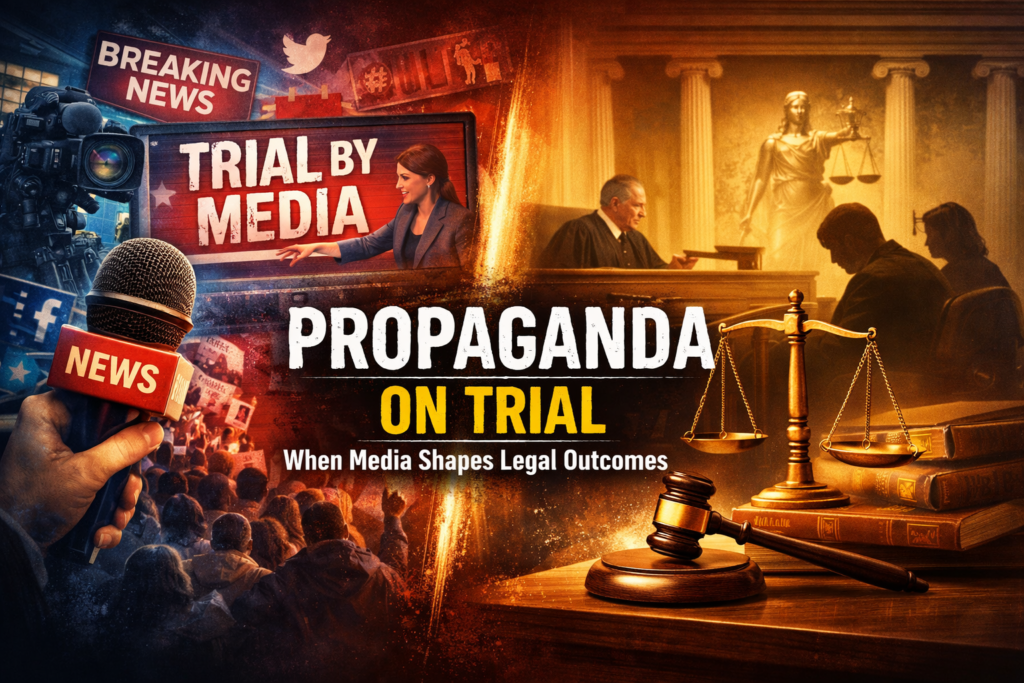
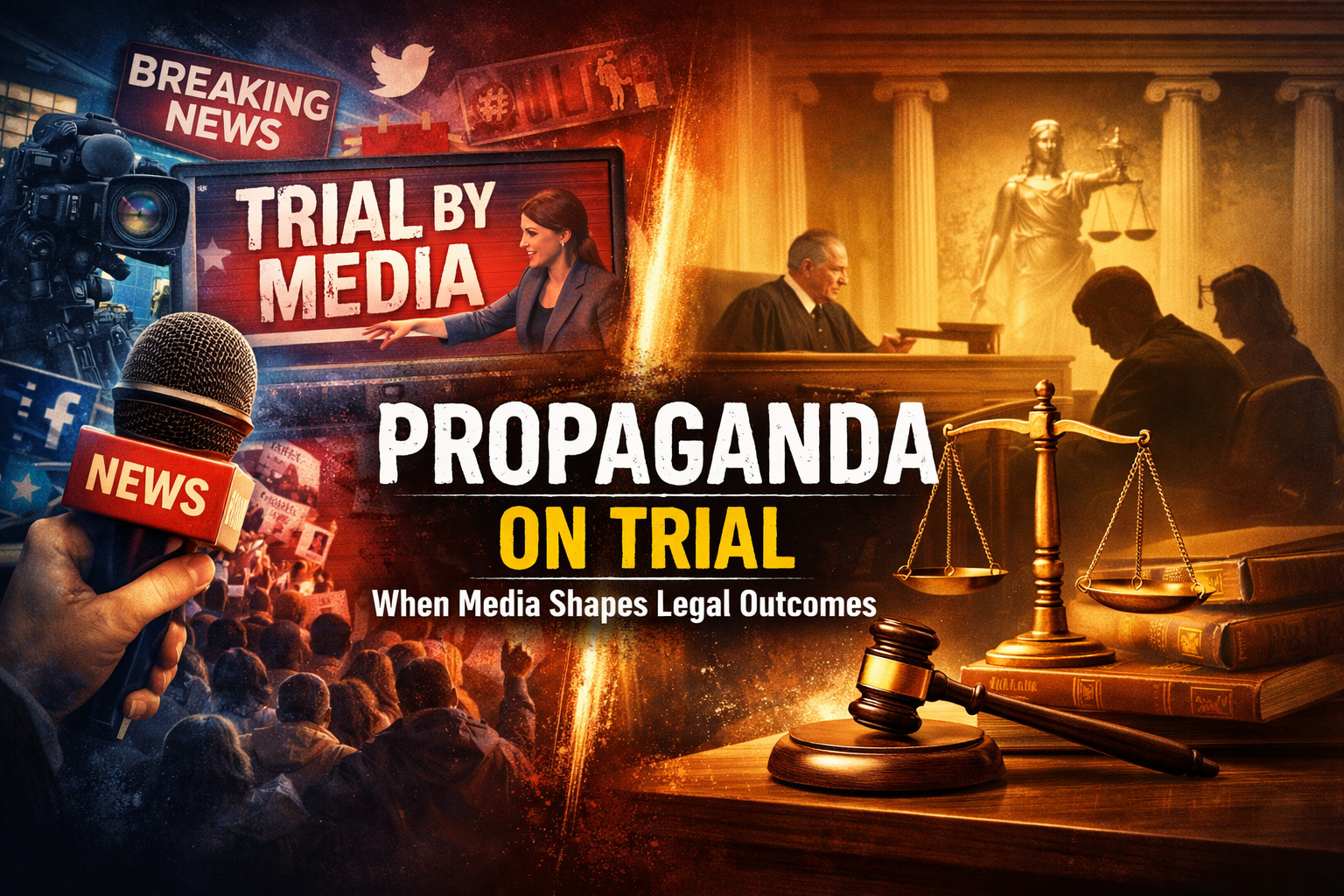
Justice is blind, but so are we when we follow the tales woven by the media in the name of news. Journalism in India has gradually shifted from merely providing information to actively constructing narratives. It often plays with the emotions of the public, derives its own conclusions, and shapes perception long before facts are judicially examined. Journalism is undeniably a powerful tool, but it is frequently misused out of greed, political alignment, and the pursuit of personal gain by various media agencies. In India, media houses often deliver “verdicts” on legal matters long before courts can, and such narratives manipulate the public like a puppet on strings. This becomes especially dangerous because a large section of society relies on the media as its primary source of information.
Information that is biased, misleading, and deliberately spread to influence people’s actions or opinions in favour of a particular cause, agenda, or institution often by appealing to emotions rather than reason is known as propaganda. In the context of media, propaganda is not limited to fake news. It includes selective truth, half-truths, emotionally framed reporting, and repeated narratives designed to shape public opinion. Media channels frequently highlight only the evidence that supports their preferred narrative, while ignoring contradictory facts. Dramatic background music, sensational headlines, edited clips, slow-motion visuals, and repeated victim photographs are often used to intensify emotional reactions. In such cases, the media does not merely report an incident; it manufactures an atmosphere.
The Media Trial
The 21st century recognizes the importance of television, newspapers, and digital media. However, what society often fails to recognize is that this influence can be deeply deleterious. The media, in several cases, aggressively and pre-emptively determines the guilt or innocence of an accused through news debates, social media discussions, and public opinion long before a formal judicial verdict is delivered. Such “trial by media” not only manipulates the minds of the public but also creates indirect pressure on the justice delivery system. It can compromise fair trials, disrupt investigations, and influence witnesses.
The consequences of media trials are severe. They damage an individual’s reputation, lead to public humiliation, and may permanently ruin the accused’s personal and professional life even if the person is later acquitted. Such media trials often violate personal rights, and in many instances, legal rights as well. Furthermore, what begins as media speculation eventually becomes a public trial, fuelled by WhatsApp forwards, memes, hashtags, and online outrage. The digital world turns into a parallel courtroom, where the loudest voice is often treated as the strongest evidence.
The Death of Presumption of Innocence
The presumption of innocence is a foundational principle of criminal jurisprudence. It states that every person accused of a crime must be considered innocent until proven guilty by a competent court of law. However, when media attempts to shape legal outcomes, this principle becomes irrelevant in the eyes of society. The accused is treated as guilty from the very beginning, and the court is often expected to merely confirm what the public has already accepted.
This principle has constitutional importance in India. It is implicitly protected under Article 21, which guarantees the right to life and personal liberty, and is closely linked with Article 20(3), which provides protection against self-incrimination. Yet, media houses often disregard such legal safeguards in pursuit of personal gain, TRP ratings, and commercial popularity. The media’s hunger for sensationalism frequently replaces constitutional values with public entertainment.
Freedom of Press vs Contempt of Court
Article 19(1)(a) of the Indian Constitution guarantees freedom of speech and expression, which includes freedom of the press. However, this freedom is not absolute. Article 19(2) provides reasonable restrictions, including contempt of court, defamation, public order, and incitement.
The media often forgets these limitations and crosses into areas that directly interfere with the administration of justice. When reporting prejudices a trial, creates bias against an accused, or attempts to influence public belief regarding a pending matter, it can amount to contempt of court. Media institutions must understand that freedom of press is a constitutional privilege, not an unrestricted licence to conduct parallel trials.
Case Studies
- K.M. Nanavati v. State of Maharashtra (1962)
This case is historically significant as it demonstrated the dangerous influence of public opinion and media on criminal trials. Nanavati, a naval officer, was tried for the murder of his wife’s lover. The case gained immense media attention and public sympathy, which played a major role in shaping perceptions of guilt and innocence. The jury acquitted Nanavati, but the High Court overturned the verdict and convicted him. This case eventually led to the abolition of the jury system in India, as it exposed how public sentiment and media influence could distort justice. The case remains widely cited as an early example of how sensationalism can interfere with legal outcomes.
- Nupur Talwar v. CBI (2012–2017) (Arushi Talwar Case)
The Arushi Talwar murder case became a national spectacle due to constant media reporting, leaks, and sensational debates. Media channels repeatedly speculated about the personal life of the victim and her family, turning the investigation into entertainment rather than factual reporting. The accused parents faced severe public humiliation and were treated as guilty long before conviction. Eventually, the Allahabad High Court acquitted them due to lack of credible evidence and serious investigative lapses. This case is often regarded as a classic example of media trial and how public perception can destroy reputation even when the accused is later acquitted.
- Sushant Singh Rajput Death Case (2020)
The death of actor Sushant Singh Rajput became one of the biggest examples of modern media trial in India. Even before any final investigative conclusion, media platforms declared multiple theories, including murder, conspiracy, and drug networks. Several individuals, including Rhea Chakraborty, were subjected to continuous public character assassination and were portrayed as guilty without trial. The case reflected how media sensationalism can dominate investigations, influence public belief, and harm the dignity and reputation of individuals. It remains a key example of social media and television journalism acting as parallel courts.
The Thin Line: Reporting vs Influencing
Reporting refers to the presentation of verified facts in a neutral tone, without conclusions or assumptions. Influencing, on the other hand, refers to emotionally manipulating the public through biased narratives, selective evidence, and premature judgments. Journalism is not judgment; it is merely the responsibility of the media to provide factual news to the public. When reporting becomes influencing, media stops being the fourth pillar of democracy and begins behaving like an unchecked authority.
Conclusion
Media possesses immense power, a power that is not granted to everyone. When used responsibly, it can assist millions by exposing injustice and ensuring transparency. However, with power comes responsibility, and the media often forgets that responsibility in the pursuit of attention and profit. It must always remain clear that only courts have the authority to decide guilt or innocence in legal matters. As much as it is the duty of the media to report truthfully, it is equally the duty of society not to blindly consume narratives that are biased and shaped by propaganda. In the end, justice demands patience, not performance. We must wait for judgments from the final authority the courts and not from the media.
References
Constitutional Provisions:
Constitution of India: Articles 19(1)(a), 19(2), 20(3), 21
Statutes:
Indian Penal Code, 1860 (Defamation Sections 499–500)
Case Laws
- K.M. Nanavati v. State of Maharashtra, AIR 1962 SC 605
- Nupur Talwar v. CBI (Arushi Talwar Case), Allahabad High Court (2017)
Other Sources:
Legal databases: SCC Online, Manupatra, Indian Kanoon