
By Dattatray Mahajan –
1st year – Government Law College, Mumbai
– Legal Intern @Singhania & Co
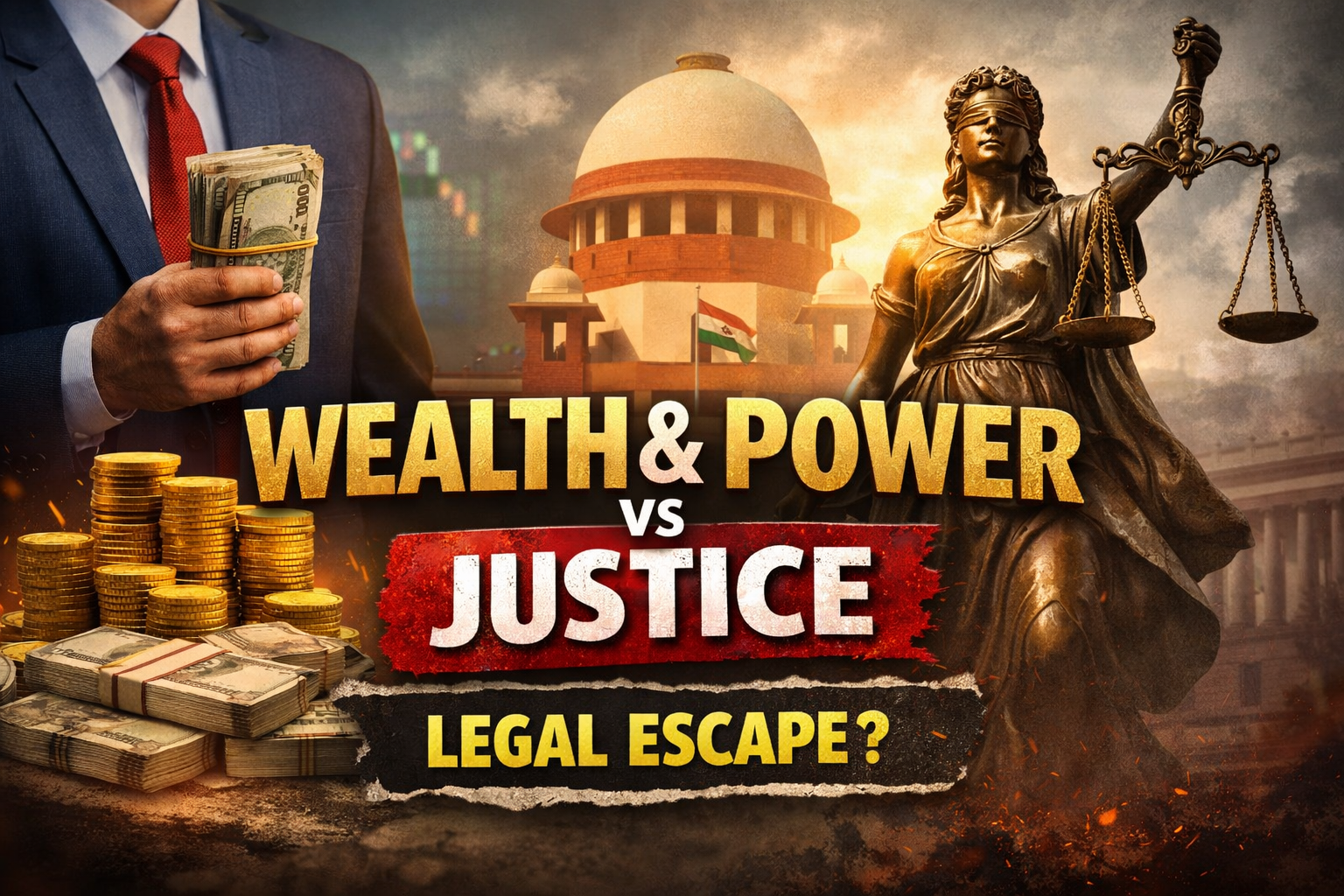
One could argue that Herbert Spencer’s theory of “Survival of the Fittest” finds a mirror reflection in the workings of the Indian legal system. In a recent controversy involving the Adani Group, allegations raised by an international research firm led to widespread public discussion and market concern. Several petitions were filed before the Supreme Court for investigating the matter through a Special Investigation Team (SIT), but the Supreme Court refused to interfere with the Securities and Exchange Board of India (SEBI) probe into the Adani–Hindenburg case.
The Court emphasised the importance of institutional autonomy and allowed the statutory regulator to continue its investigation within the existing legal framework. While this approach was consistent with principles of judicial restraint and separation of powers, it also sparked wider public debate about accountability in cases involving vast economic influence.
If we put a closer eye to examination, the relationship between wealth and accountability reveals that legal outcomes emerge from spaces of interpretation rather than certainty. In many disputes, more than one legally defensible conclusion may exist. Where such alternatives affect different social groups differently, those with greater economic resources are often better equipped to advocate for the interpretation that aligns with their interests and protects them from legal obligation. Importantly, this does not necessarily imply illegality or judicial impropriety; rather, it highlights how access, endurance, and influence within lawful processes can shape the practical direction of justice.
Shaping the Battlefield Before Trial
In today’s era, justice is not merely about declaring what is right or wrong; it has become like an athlete in a marathon. The destination remains fairness, but the journey toward it unfolds gradually and under constant public observation. Every stage of the process is examined, debated, and interpreted beyond the courtroom through news reports, expert commentary, and social media discussions.
This is exactly where economically stronger actors often enter the courtroom with greater preparation and endurance. Their advantage may not lie in altering the law, but in navigating it more effectively. Through strategic communication, engagement with media platforms, expert opinions, policy advocacy, investor briefings, and coordinated digital campaigns, they are able to influence how the dispute is perceived by the wider public. Such efforts may operate within legal limits, yet they help shape the narrative climate in which justice progresses.
This gap between perception and process is where concerns about “survival of the fittest” begin to surface. The issue is not that justice is denied, but that justice appears uneven when resources determine who can sustain the marathon longer and shape the surrounding narrative more effectively.
The Settlement Loophole
This “Settlement Loophole” refers to situations where wealthy individuals or corporations use financial settlements to avoid full legal accountability. Instead of facing a trial or strict penalty, cases are resolved through fines or compensation, often resulting in withdrawal, reduction, or quiet closure. Money, in this sense, acts as a protective shield, allowing those with economic power to escape harsher consequences while remaining within the legal framework.
Beyond the immediate legal outcome, such settlements can shift public perceptions that justice is uneven and conditional on resources. Limited transparency and reduced public scrutiny often amplify this effect, demonstrating how procedural flexibility, when combined with wealth, shapes not only legal outcomes but also societal perceptions of fairness.
Delayed Justice
Another weapon is the unnecessary prolonging of cases. Extended litigation can stretch for years or even decades, giving those with greater resources a distinct edge. Affording high-quality legal counsel, attending repeated hearings, and covering procedural costs can be challenging for ordinary citizens, while wealthier parties navigate the system with relative ease.
Extended timelines also allow parties to manage narratives, prepare expert evidence, or negotiate settlements under reduced scrutiny. Appeals, revisions, and reviews are merely added drops to a lake full of complexities.
Strengthening Accountability and Access to Justice
To ensure that justice works fairly for everyone, reforms need to address each way economic or powerful actors can influence the system. Settlement loopholes can be managed by increasing transparency, so financial resolutions do not allow parties to quietly avoid accountability.
The impact of media and narrative shaping can be balanced through responsible reporting, clear communication from regulators and courts, and timely updates on ongoing cases, helping the public understand what is actually happening. Prolonged litigation can be reduced with time-bound procedures, better case management, and fast-track courts, preventing resources alone from deciding who can stay in the legal “marathon” longer.
Strategic use of technicalities, repeated petitions, or complex procedures can be checked through strong judicial oversight and standardized rules. Finally, expanding legal aid, alternative dispute resolution, and expert support ensures ordinary citizens can use the system as effectively as the well-resourced. Together, these steps can make the legal system more balanced, maintain public trust, and ensure that justice is not just done, but seen to be done.
The Finish Line of Justice
Justice in today’s world is like an athlete running a long marathon. The finish line represents fairness and equality, but the journey is shaped by resources, strategy, and public perception. Economically powerful actors can influence the course through settlements, media narratives, prolonged litigation, and procedural manoeuvres, while ordinary citizens face greater challenges in keeping pace.
Yet, the legal system is guided by the principle that “where there is a right, there is a remedy.” The goal is not to remove all challenges from the marathon, but to ensure that every participant, regardless of resources, can meaningfully pursue their rights and reach the finish line. Only then can justice be truly impartial, credible, and inclusive.