


Imagine a scenario where you are accused of an offence and you are yourself giving evidence to prove that you are guilty of the said offence. To make it sound simple and convincing, you are the one who is proving the system to keep you behind bars. Sounds hilarious, right?
The notion that an accused person could be compelled to participate in his own conviction by providing evidence that directly establishes his guilt is fundamentally inconsistent with the principles of fairness and justice that underpin a democratic legal system. It was precisely this fear of governmental overreach that led the framers of the Indian Constitution to incorporate Article 20(3), which enshrines the classical Latin maxim nemo tenetur seipsum accusare, meaning that no person should be forced to accuse himself.
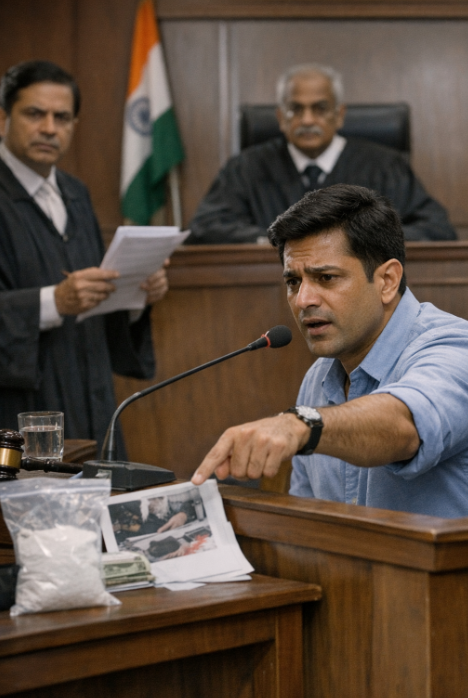
Article 20(3) guarantees that no person accused of an offence shall be compelled to be a witness against himself, thereby ensuring that criminal law in India remains adversarial rather than inquisitorial in nature.
When read in its plain meaning, the provision conveys that no individual can be compelled by threats, coercion, or any form of pressure to provide testimony or evidence which has the potential to incriminate him or her.
Early Judicial Interpretation
The earliest authoritative interpretation of this article came through the Supreme Court’s decision in M.P. Sharma v. Satish Chandra (1954), where the Court held that the right against self-incrimination is available only to a person who is formally “accused of an offence”, meaning that the protection is triggered only when a formal accusation or FIR has been made.
The Court also emphasized that the protection includes a right against any form of compelled testimony and observed that the scope of the phrase “to be a witness” is not limited strictly to oral testimony in court but extends to any compelled communication that may incriminate the accused.
However, this broad interpretation eventually raised concerns that the accused could misuse Article 20(3) to obstruct legitimate investigation, since, if taken literally, it would prevent the police from obtaining even basic physical evidence such as fingerprints, handwriting samples, signatures, and blood specimens—all of which are indispensable for modern criminal investigation.
Distinction Between Testimonial and Physical Evidence
To address this problem, the Supreme Court revisited the scope of Article 20(3) in the landmark case State of Bombay v. Kathi Kalu Oghad (1961), where an eleven-judge bench significantly narrowed the ambit of the phrase “to be a witness.”
The Court drew a crucial distinction between testimonial compulsion, which involves conveying personal knowledge through verbal or written statements, and physical or real evidence, which includes bodily features or physical characteristics. The Court held that compelling an accused to provide fingerprints, handwriting samples, voice samples, footprints, blood samples, or other bodily materials does not violate Article 20(3), since these do not require the accused to disclose personal knowledge or mental content.
This ruling aligned Indian jurisprudence with comparative constitutional practice, particularly decisions of U.S. and U.K. courts, which differentiate between revealing the “contents of the mind”, which is protected, and providing physical evidence, which is not. Thus, Kathi Kalu Oghad ensured that while the accused remains protected from compelled self-incriminatory testimony, the State’s investigative powers are not unduly handicapped.
Right to Silence and Police Interrogation
The contours of Article 20(3) were further developed in Nandini Satpathy v. P.L. Dani (1978), a case where the former Chief Minister of Odisha refused to answer police questions during interrogation and claimed protection under Article 20(3).
The Supreme Court adopted a rights-expansive view and held that the right against self-incrimination is not confined to the trial stage but extends even to police interrogation. Importantly, the Court recognized the right to silence as a constitutionally protected entitlement, declaring that an accused—or even a suspect—cannot be compelled to answer questions which may expose them to criminal charges.
The judgment also stressed the need for dignified treatment of individuals during interrogation and acknowledged that the presence or consultation of legal counsel during questioning forms part of fair procedure under Articles 20(3) and 21. This case substantially strengthened procedural safeguards by ensuring that interrogation tactics do not devolve into coercion, intimidation, or psychological pressure.
Scientific Tests and Mental Privacy
As forensic science advanced, a new legal dilemma emerged regarding whether the State could compel an accused to undergo scientific tests such as narcoanalysis, polygraph examinations, and brain-mapping (BEOS). These tests raised profound concerns because, unlike fingerprints or blood samples, they probe the mental processes of the individual.
The Supreme Court addressed this issue definitively in Selvi v. State of Karnataka (2010), holding that forcibly subjecting an accused to such tests violates the right against self-incrimination and the broader right to mental privacy under Article 21. The Court reasoned that these scientific procedures extract information from the accused’s mind without their conscious and voluntary participation, thereby directly infringing the autonomy and dignity of the individual.
It was further held that no information obtained through such involuntary tests can be admitted as evidence in court. This judgment positioned India as one of the few constitutional democracies to give explicit protection against involuntary neuroscientific interrogation, highlighting the judiciary’s commitment to bodily integrity and mental liberty.
Article 20(3) in the Digital Age
In the modern digital age, Article 20(3) has taken on renewed significance, particularly with the widespread use of smartphones, encrypted data, and biometric authentication. Courts have increasingly applied the principle laid down in Kathi Kalu Oghad to distinguish between compelling biometric information, such as fingerprints or facial recognition—which are generally permissible as they constitute physical evidence—and compelling passwords, PINs, or encryption keys, which are impermissible because they involve disclosing personal knowledge and thus constitute testimonial compulsion.
This nuanced distinction continues to evolve, especially in cases involving encrypted devices and digital privacy concerns under Article 21.
Conclusion
Despite these complexities, the core objective of Article 20(3) remains constant: to prevent the State from exploiting its dominance to extract self-incriminatory testimony from citizens. Through a series of landmark judgments—from M.P. Sharma to Kathi Kalu Oghad, Nandini Satpathy, and Selvi—the Supreme Court has refined and expanded the contours of this constitutional protection, balancing the need for effective investigation with the imperative of safeguarding individual liberty.
The right against self-incrimination today stands not merely as a procedural safeguard but as an essential component of human dignity, personal freedom, and the presumption of innocence, ensuring that no individual is compelled, directly or indirectly, to participate in securing his own conviction. In this way, Article 20(3) continues to uphold the foundational constitutional principle that the burden of proving guilt always lies upon the State, and the accused cannot be forced to assist in that endeavour.
REFERENCES
- The Constitution of India
- M.P. Sharma v. Satish Chandra, 1954 SCR 1077
- State of Bombay v. Kathi Kalu Oghad, 1962 SCR (3) 10
- Nandini Satpathy v. P.L. Dani, (1978) 2 SCC 424
- Selvi & Ors. v. State of Karnataka, (2010) 7 SCC 263