
Free Speech and Deepfakes
A farmer from Roorkee, named Yogesh Saini, was defrauded of Six Lakh rupees by cybercriminals using a deepfake video call by impersonating his son. An FIR was filed against a social media user, Jagman Samra, for defamation and misuse of technology as he circulated the deepfake video of Punjab CM Bhagwant Mann indulging in an obscene act.
Deepfakes are AI-generated synthetic media producing hyper-realistic simulations that depict people saying or doing things they actually never did. Most prevalently, deepfakes are being used for the spread of misinformation with the aim to gain something, or to earn profits in a mala fide way; otherwise, to cause loss to someone; to hurt, to defame or to bully someone. Deepfakes have raised serious issues in the present times, such as
- Increased cybercrime and economic risks
- Risks related to public order and National Security
- Concerns related to Elections and Democracy
- Erosion of reliability
- Threats related to privacy and dignity
- Conflict with Free Speech
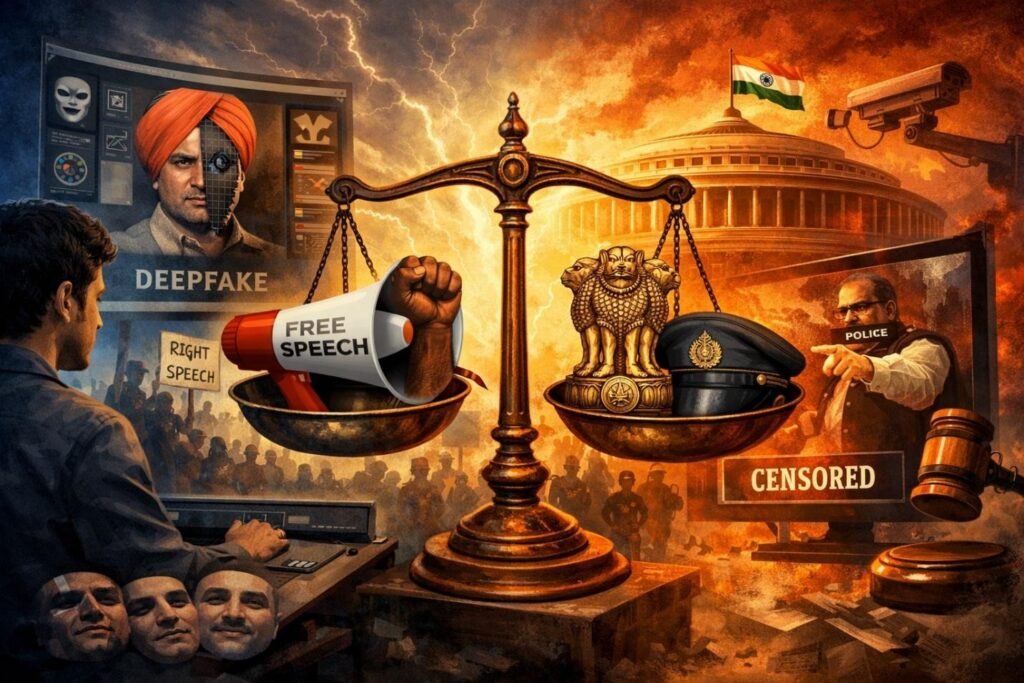
Synthetic media or deepfakes can be used for legit purposes, such as political criticism, parody, art, and satire. But governing authorities may suppress such works by illegitimately using their control and disguising it as a measure to avoid harm by deepfakes. Over-regulation by the government can affect free speech negatively and could chill legitimate expressions. Here comes the key concern: where should the line be drawn between free speech, deception by synthetic media and control of the state over them?
Free speech is protected under Article 19 (1a) of our Indian Constitution as a freedom of expression. Use of deepfakes for satire, art, research, journalism or for any other legit purposes may fall under protected speech. Use of deepfakes is completely valid in such circumstances. But free speech also comes with reasonable restrictions. Free speech is not absolute. Article 19 (2) of the Constitution allows such restrictions against freedom of expression. Under this article, restrictions on free speech are justified for morality, defamation, national security, public order, and dignity. When there is a clash between deepfakes and state control, passively, it creates a clash between free speech and state control. Here, things get a bit trickier. Where a state has the power to regulate and control fake content, alternatively, states may disguise their authority to define truth as per their will. Overbroad laws against synthetic media will create chilling effects. And then, to avoid trouble and difficulties of legal and penal actions, people will abstain from posting, sharing media against the state, out of fear. It raises a core legal challenge about censoring deepfakes without affecting free speech.
State Control and concerns around it…
States, under the guise of controlling the misuse of deepfakes, can create problems such as stringent surveillance and censorship risks. States may justify their actions, such as content filtering, mass surveillance, political censorship and criminalisation of dissent, as measures taken against acts under deepfakes. This will raise concerns of authoritarian control, prior restraint and abuse of digital governance laws. Looking at the legal perspective, poorly drafted laws against deepfakes may penalise or criminalise actions such as parody, artistic AI content or political criticism. Such moves will violate the principles of legality and proportionality.
Governments may impose mandatory takedowns and force digital platforms to remove harsh political satire on the grounds of being deceptive content. Actually, satire and parody are protected expressions. ‘Truth’ is not a mandatory requirement for free speech. Laws against deepfakes need to be specific in approach. Vague definitions using terms like ‘misleading’ or ‘harmful’ are subjective, broadening the scope of inclusion to any act or content in it. This ambiguity can prove useful for the state to use against or to silence dissenters. The overbroad laws will create a chilling effect, and people will hesitate to speak against authorities in fear of accidental legal trouble. Thirdly, ‘anonymity’ is crucial and acts as a shield for activists who expose illegal activities, fraud or wrongdoings of an organisation to all others and to the public at large. The state may, by standing behind the curtains of precautionary measures against misuse of deepfakes and AI, compel users to verify their identity to post AI content; this will end online anonymity, affecting the free speech of a person.
Now, thinking of solutions that can be implemented against such concerns, we may need a ‘defence in depth’ strategy for solving this deepfake dilemma.
Legal and Regulatory solutions
First, looking at legal and regulatory solutions,
- Law must be specifically targeted to specific offences like non-consensual sexual deepfakes, election interferences, fraud and impersonation, terror propaganda, with the key principle that there must be an intention to harm, and it must be proven along with the proven harm that occurred.
- There must be a mandatory disclosure and labelling of AI-generated content. India is also implementing rules requiring AI content to carry a visible label. AI-generated content should be watermarked, traceable via metadata and must be labelled as synthetic. This move will help to preserve speech while reducing deception.
- There must be civil liability and a tort remedy against it. The victim should have the right to sue for damages, the right to erasure and the right to be forgotten, along with the injunctions to remove content.
- Concerning the judicial safeguard, there must be judicial oversight; any censorship or takedown must follow due procedure and process. It must be a subject for review. Executive arbitrariness must be avoided while doing so.
- As part of electoral safeguards, the Election Commission should monitor AI disinformation and criminalise election-related synthetic manipulation. The Election Commission should also spread public awareness through campaigns.

Technological solutions
Now, moving ahead with technological solutions,
- There must be a digital paper trail. The data tracks and history should be stored under the metadata with the help of software. History of the file, manipulations, publishing, and editing of the file; everything should be stored under it as history to trace its origin and track its record. This is called the Digital Provenance Framework (C2PA Standards).
- Watermarking is a great tool to separate the synthetic media. Major platforms like Meta, OpenAI and Google are shifting towards an invisible but non-removable watermark that informs social media and browsers about the content that is made with an AI.
- Social media platforms should flag synthetic media content, remove malicious deepfakes and provide for rapid takedown mechanisms. And, states should hold the platform responsible if it fails to remove flagged, malicious, harmful deepfakes within the stipulated time.
The main goal behind implementing these many measures is not to disable the technology or bar the use of Deepfakes. It can be used in making incredible things out of imagination, to create miraculous shots in movies. The main goal is to create transparency about ‘fake media’ and to spread awareness about it; to separate ‘real content’ for its credibility and authenticity; in addition, to avoid its misuse by making excuses under the ambiguity existing between authentic and deepfake media.
Incidents and Cases related to it…
The most widely known case related to deepfakes in India is
Rashmika Mandana Deepfake Case (Delhi, 2023)
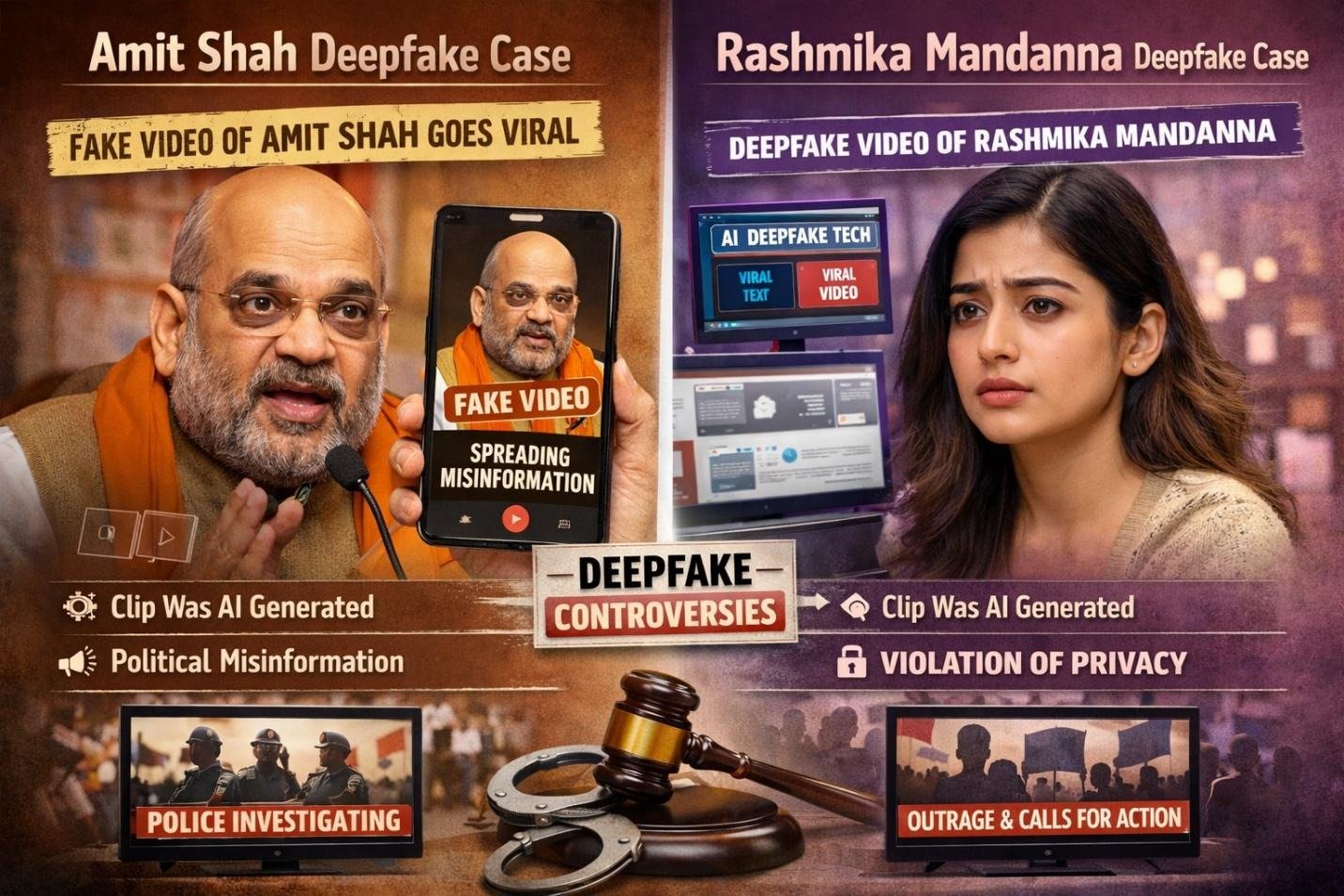
In this case, four individuals were arrested for creating and disseminating a non-consensual deepfake video of the actress. All four were arrested under Sections 66D and 66E of the IT Act. The case exposed delays in tracing perpetrators across platforms, but highlighted the applicability of cybercrime laws. This case showed the enforcement difficulties and platform accountability gaps.
Another highlighted case is that of our present Home Minister,
Amit Shah Deepfake Case (Delhi, 2024)
In this case, two individuals were arrested for circulating a manipulated video of the Home Minister representing him claiming changes to reservation policies falsely. The case prompted the Election Commission of India to issue stricter guidelines against AI misuse. Both accused were charged and arrested under Sections 66C and 66D of the IT Act, and under Sections 153A and 468 of the IPC. Primarily, they both were arrested for spreading misinformation and forgery. This case highlighted the election-related AI misinformation risks.
Gautam Gambhir’s plea in the Delhi High Court (2026)
Most recently, Gautam Gambhir, the current Head Coach and former player of the Indian cricket team, has filed a plea in the Delhi High Court seeking protection of his personality and publicity rights against unauthorised deepfake content and digital impersonation. Gambhir showed for record several deepfake videos of himself going viral on social media, spreading misinformation in recent times. It also includes a purported “resignation announcement” which went viral and gained 29 lakhs views. Gambhir has stated his concern that his identity is being used by anonymous entities to spread misinformation and generate revenue.
The suit has been filed under provisions of the Copyright Act, Trade Marks Act and the Commercial Courts Act, and has sought a permanent injunction restraining others from using, reproducing or exploiting his identity using deepfake and AI technologies without any express written consent. Additionally, he seeks damages of Rupees 2.5 crore, rendition of accounts, and directions to remove and take down all infringing content. The suit is still going on in the court.
Looking at the comparative legal developments, there are no rules made specifically to address issues related to AI and Deepfakes in India; but laws under IT Rules 2021 and upcoming Digital India Act proposals, along with privacy jurisprudence under Puttaswamy Case provides for remedies against AI misuse, deepfakes and synthetic media.
Considering the global perspective, China has made it mandatory laws for labelling synthetic content. Under the European Union, the AI Act and the Digital Services Act impose transparency and duties on platforms. The right to be forgotten is an effective remedy that helps the victim to gain relief considerably. In the USA, several state laws have criminalised the non-consensual deepfake pornography; they have issued federal proposals for election-related Deepfakes.
Author,
SANGRAMSINGH SENGAR
Intern at SINGHANIA & Co. LLP.
First Year Student of LL.B.
Government Law College, Churchgate, Mumbai.
References
- Article by Lawvs.com https://lawvs.com/articles/deepfake-regulation-vs-free-speech-should-india-criminalize-ai-generated-deepfakes-under-fundamental-rights-concerns?hl=en-IN
- Oxford Academic Journal https://academic.oup.com/cybersecurity/article/11/1/tyaf008/8127651?hl=en-IN
- ElectroIQ https://electroiq.com/stats/deepfake-statistics/
- Record of Law https://recordoflaw.in/deepfakes-and-the-law-addressing-legal-accountability-for-ai-generated-misinformation/
- Lawful Legal https://lawfullegal.in/legal-responses-to-deepfakes-and-ai-generated-misinformation-in-india-challenges-and-emerging-regulatory-frameworks/
- Article by Abhay Jain https://law.shodhsagar.com/index.php/j/article/view/
- Images used here are made by A.I. using ChatGPT with an ethical motive for the purpose of information, and there is no wrongful intent behind it.