


INTRODUCTION – WHY IT MATTERS?
In India, the laws related to damages given to victims in case of fatal accidents are so inconsistent, statutorily and judicially, that they fail to fulfil the purpose for which they are meant. Out of all the claimants who knock on the doors of court for justice, just 33% got results in their favour, the other 34% got awards against them, and the remaining 33% cases remain pending in courts for years, the duration can range anywhere between 1 year to 9 years. Sometimes the cases may even stretch for more than 25 years. According to a survey, the mean time for the court’s verdict to come out remains around 3.6 years.
The situation goes even worse when the person who died was the sole breadwinner. Most of the time, compensation is a sum of money that only covers the direct losses and loss of quality of life. It often ignores the aspiration and ‘Lost-opportunities’. Compensation is often a long and frustrating process, and people settle for a derisory amount due to the burden of the hectic and lengthy legal process. Motor Accidents Claims Tribunals (MACT), in cases where there has been a major road accident that grabs the attention of the media and political parties, MACTs often announce the compensation of either 2,00,000 or 5,00,000 rupees. Still, such compensation schemes can be good for short-term relief only.
Ram Singh, in his JNU research study on Motor Vehicles Accidents in India, highlighted a few accidental cases of the years 1984-85 in which a nine-year-old boy was hit by a bus and died. So, on account of loss of independence, the boy’s parents were awarded a compensation of Rs. 18,000 by the tribunal. The award was backed by the Andhra Pradesh High Court. And, in a similar type of case, another nine-year-old boy was run over by a bus, resulting in his death. Compensation of Rs. 8,000 was awarded to his parents. All such cases lead to the conclusion that there are significant inconsistencies and disparities while awarding compensation for fatal accidents. These compensations for fatal accidents are primarily governed by the Fatal Accidents Act, 1855 and the Motor Vehicles Act, 1988.
The Fatal Accidents Act, 1855, emphasizes compensation proportioned to the loss resulting from such death; it is typically called pecuniary loss or loss of financial dependency. It is an outdated notion as this kind of approach inherently undervalues non-earning individuals like homemakers, students, or the unemployed, and results in vastly different compensation awards for individuals with different incomes. The core issue in fatal accident damages claims is the conflict between the principles of providing just compensation (which varies based on individual loss) and the ideal of equal valuation of human life.

LAWS RELATED TO FATAL ACCIDENT DAMAGES
Looking at the statutory architecture for fatal accident damages in India, compensation can be claimed under various statutes like the Motor Vehicles Act, the Fatal Accidents Act, the Employees Compensation Act, and the Railways Act, each with different rules, limits, and scopes. The Motor Vehicles Act, 1988, is a primary statute governing third-party motor accident compensation. Section 163A of this Act provides for no-fault compensation, and sections 166 & 168 provide for fault-based claims. Section 163A of the Motor Vehicles Act awards compensation for death or any grievous hurt without any requirement for proof of fault. Under this section, a fixed revised amount of Rs. 5,00,000 is given in case of fatal accidents for quick relief. Under sections 166 and 168 of the Motor Vehicles Act, claimants can opt for just compensation instead of the fixed amount given in section 163A.
This just compensation is calculated based on the multiplier method and heads laid down by courts, like loss of dependency, future prospects and conventional heads like loss of estate & funeral expenses. Courts generally prefer using judicial formulas evolved through precedents. There has been an overlap and practical tension between the choice of remedy under section 163A as fixed amount compensation of five lakh rupees and claiming full damages under sections 166 and 168. The Fatal Accidents Act, 1855, allows the spouse, parents, children or any other dependents of a person to file for compensation when a person dies due to another’s default, neglect or wrongful act. Here, damages are calculated on the basis of the deceased’s age, future income, financial status and dependency; and then courts decide the compensation proportionally.
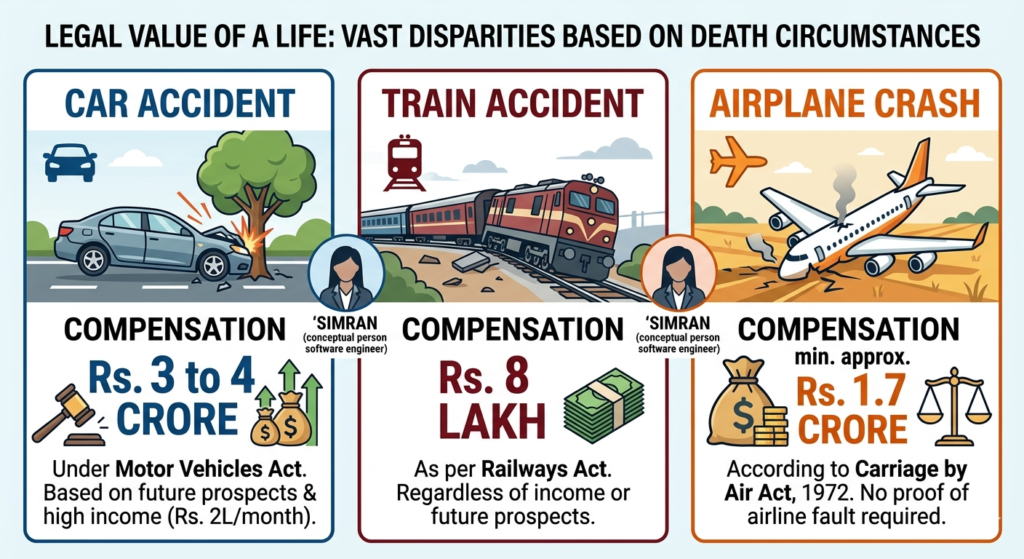
The way the Indian legal system evaluates human life. It looks like a startling paradox. The Constitution guarantees the right to life under Article 21, but the statutory framework for compensating the loss of that life is often discriminatory, fragmented and inconsistent. The primary source for unequal compensation lies in the different statutes governing various modes of transport. Let us understand the disparity in compensation for a single deceased individual with the help of an example. Imagine Simran is a software engineer earning Rs. 2 lakh per month. And, if she dies in a car accident, her dependents or family can file a claim for compensation under the Motor Vehicles Act. The family may receive upwards of Rs. 3 to 4 crores based on future prospects as compensation. And, if Simran dies in a train derailment or train accident. Then, as per the Railways Act, her family or dependents are entitled to only Rs. 8 lakh as compensation, regardless of her income or future prospects. And, if she dies in an airplane crash, according to the Carriage by Air Act, 1972, her family will receive a minimum of approximately Rs. 1.7 crores without even proving the airline’s fault. We can see from this example that in the eyes of the law, a person’s worth depends drastically on whether they died in a car, train, airplane, or any other circumstances.
JUDICIAL EVOLUTION AND LANDMARK JUDGEMENTS
Several attempts have been made by the judiciary, led by the Supreme Court, to standardize the compensation under Fatal Accident Damages in India. Several concepts, formulas and ideas were brought under the action to bring uniformity in Motor accident claims under a few highlighted cases like Sarla Verma Case (2009), Pranay Sethi Case (2017) and Preetha Krishnan vs. United India Insurance (2025) case. The judgments in these cases helped in the approach to standardize motor accident claims, but these standards do not apply to Railways and other statutory caps. Let us discuss these cases one by one.
- Sarla Verma vs. DTC (2009);
This case brought the “Sarla Verma” formula as,
Total Compensation = (Income – Personal Expenses)
Here, the Court implemented a standardized “multiplier” based on age to ensure some uniformity in Motor Accident Claims Tribunals (MACT). It formulated the appropriate multipliers by age, approach to deduction for personal expenses and proof of income. This was a landmark guidance on the multiplier method. The courts rely heavily on this formula to calculate dependency and the multiplier to determine the value of the compensation.
- National Insurance Co. Ltd. Vs. Pranay Sethi (2017);
The Court drew a landmark judgement, and the constitution bench standardized the “future prospects”; it was an idea about the person’s income, which would have grown over time. The constitution bench made clear the heads of compensation and framed a valid and reasonable quantum for conventional heads like loss of estate, loss of consortium & funeral expenses. And, also guided future prospects like percentage additions depending on age and repeated need for uniformity. Broadly, the percentage additions are determined as follows in the Pranay Sethi case;
- 40% addition for deceased below 40 years of age, either self-employed or salaried.
- 25% addition for salaried or self-employed people between the ages of 40 and 50 years.
- 10% addition for people between the ages of 50 and 60 years.
This case also attempted to standardize conventional heads to reduce variance.
- Preetha Krishnam vs. United India Insurance (2025):
In this landmark case, the Supreme Court, in its November 2025 ruling, definitively rejected the split multiplier concept. Post-Pranay Sethi jurisprudence, High Courts and Supreme Court continued to grapple with inconsistent multipliers to different components and with split-multiplier practice. Some High Courts were reducing the multipliers significantly after the “age of retirement” of the deceased, and courts in 2024-25 have criticized the lack of uniformity and barred certain practices such as split-multiplier approaches in some recent rulings. The Supreme Court ruled that superannuation is not an exceptional circumstance or ground to reduce the compensation.
There have been multiple judgments and recent Supreme Court observations that show the persistence of variability and the need for tribunals to have clearer guidance in determining a fair amount of compensation.
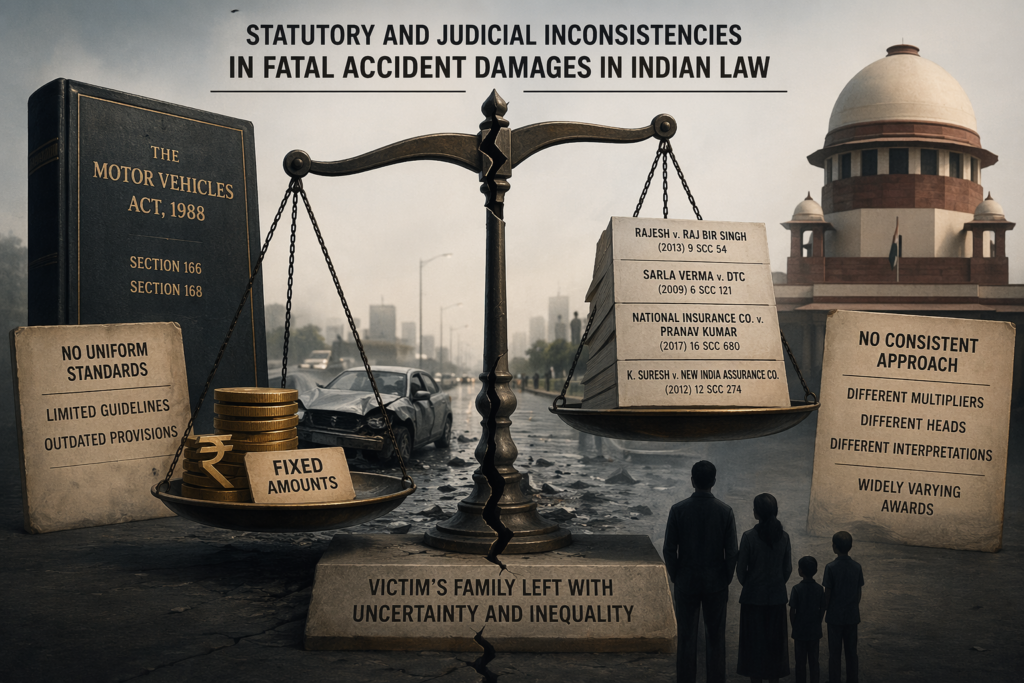
POLICY AND JUDICIAL REFORM OPTIONS
The following reforms can be proposed or recommended to avoid or lower the statutory and judicial inconsistencies in fatal accident damages in India.
- The Motor Vehicles Act can be amended to clearly harmonize section 163A with sections 166 & 168. Section 163A can be used for strict interim payment with a mandatory right to seek damages under sections 166 & 168 later by making an automatic adjustment to the final award.
- There should be a binding, indexed national grid as a National Compensation Grid that will create a binding schedule for multipliers (Age x Multiplier x Income bands) that tribunals must follow without any adjustments or diversion. Those guidelines must be followed mandatorily for tribunals, and in case of exceptional circumstances, are to be recorded in writing to reduce arbitrariness.
- To prevent under-valuation where formal proof is missing, there must be standardized evidentiary rules for national income. There must be guidelines for imputing income, such as setting a minimum threshold for educated and self-employed victims to help prevent under-valuation of their notional income and compensation.
- Statutory caps can be linked to the Consumer Price Index (CPI), so that they can update automatically every 3 years. Indexing conventional heads and multipliers to inflation every 3 years, as recommended in the statutory formula, ensures that periodic indexing in the Pranay Sethi idea of periodic enhancement can be formalized.
- Strengthening ADR and fast-track benches for domestic fatality claims will allow faster procedures and incentives for early settlements. Allowing the immediate release of no-fault 163A payment with clear offsetting rules will also help to reduce the burden. Plus, there must be maintenance of a searchable national database of MACTs and High Court awards.
- There must be regularly updated training and bench books for tribunals. Circulating a bench-book summarizing the Sarla Verma Case, the Pranay Sethi Case, and later clarifications with computation templates will encourage uniform application.
- The Indian Judiciary can also opt for a unified compensation code. Moving away from separate and fragmented statutes towards a single, organized “Accident Compensation Act” that shall treat all victims equally will help in reducing inconsistencies in fatal accident damage compensation significantly.
- Abolition of slabs for compensation under the Railways Act, 1989 and replacing the flat Rs. 8 lakh awards with the “Multiplier Method” used in road accidents can help to draw fair compensation for fatal accident damages. Additionally, compulsory insurance for the Railways (as there is in Motor vehicles) will shift the burden from the government’s exchequer to insurance pools, and it will allow higher payouts or higher awards for damages.
The above-cited recommendations can be helpful in resolving and reducing the statutory and judicial inconsistencies in fatal accident damages in an effective manner.
CONCLUSION
Although the statutes related to compensation against Fatal Accident damages are inconsistent and lead to arbitrariness, with the help of constant and necessary amendments in the related Acts, there has been quite an improvement in bringing fairness and uniformity to the compensation awarded to claimants. Yet, multiple aspects and approaches to these Acts require improvement to ensure social justice and equal compensation for the victims in fatal accidents. There have been several landmark judgments like the Sarla Verma Case (2009) and Pranay Sethi Case (2017), and the recent case of Preetha Krishnan vs. United India Insurance (2025). Laws related to accident claims will improve over time with the arising need for changes and improvements in the concerned statutes. As a result, interpretation of statutes will be made in accordance with the requirements and necessities of society, with the recommendations of the judiciary. With the help and support from the legislature, necessary changes and improvements can be achieved much sooner and in an effective manner. As a result, concerns related to unequal compensation for equal persons under fatal accident damages due to judicial and statutory inconsistencies in India can be resolved on a prior basis.
Citations
- A study of Motor Vehicle Accidents in India by R.Singh (JNU Paper)
- The Fatal Accidents Act, 1855
- The Motor Vehicles Act, 1988
- The Railways Act, 1989
- The Carriage by Air Act, 1972
- Sarla Verma & Ors. vs. Delhi Transport Corp. & Anr. (2009)
- National Insurance Co. Ltd. vs. Pranay Sethi (2017)
- The Employees Compensation Act, 1923
- Preetha Krishnan vs. The United India Insurance Co. Ltd. (2025)
- “Supreme Court bars split multiplier in Motor Accident compensation” article from courtkutchery.com
By Sangramsingh Sengar
Govt Law College, Churchgate
Mumbai