

SUSTAINABLE HARNESSING AND ADVANCEMENT OF NUCLEAR ENERGY FOR TRANSFORMING INDIA, 2025 (also known as “SHANTI”).
Legal Update.
-BY KHAN TUBA.
Legal Intern @Singhania&Co.
Nuclear power helps make clean energy for AI and green factories and is an efficient source of electricity. With over 20 operational nuclear reactors, India has a current installed capacity of around 8.18 GW. The country aims to significantly expand its nuclear power capacity, targeting 100 GW by 2047. To achieve this goal, India is focusing on research and development of advanced nuclear technologies, including Small Modular Reactors (SMRs) and indigenous reactor designs like the Bharat Small Reactors (BSRs). Nuclear power offers several benefits, including reduced greenhouse gas emissions, energy security, and economic growth. However, ensuring safety, addressing public concerns, and strengthening regulatory frameworks remain crucial challenges for the industry. Despite these challenges, nuclear power is poised to play a significant role in India’s energy future.
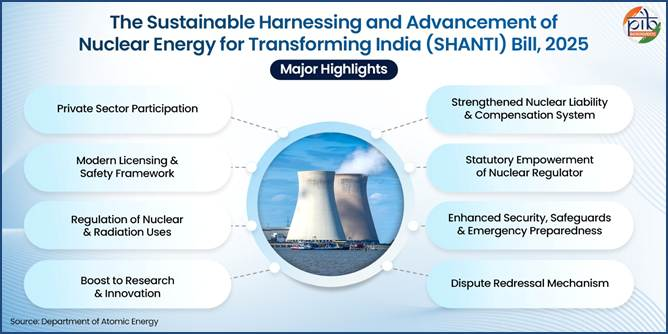
- For the first time since Independence, the Bill permits private Indian companies, joint ventures, and foreign entities to build, own, operate, and decommission nuclear power plants, ending the monopoly of Nuclear Power Corporation of India Ltd (NPCIL) in plant operations. While allowing private participation, the Bill retains government control over sensitive areas such as nuclear fuel production, heavy water manufacturing, and radioactive waste management, safeguarding national security and non-proliferation commitments. The SHANTI Bill repeals the Atomic Energy Act, 1962 and the Civil Liability for Nuclear Damage Act, 2010, creating a single, consolidated legal framework to govern India’s civil nuclear energy sector and simplify regulatory and liability procedures.
- Prime Minister Narendra Modi has warmly welcomed the passage of the Sustainable Harnessing and Advancement of Nuclear Energy for Transforming India (SHANTI) Bill, hailing it as a landmark moment for India’s technological advancement. In a social media post, PM Modi expressed his enthusiasm, describing the development as a “transformational moment” for the country’s technology landscape. The Prime Minister, Shri Narendra Modi has welcomed the passage of the SHANTI Bill by both Houses of Parliament. Expressing gratitude to Members of Parliament for supporting the Bill, the Prime Minister said that it will safely power Artificial Intelligence, enable green manufacturing and deliver a decisive boost to a clean-energy future for the country and the world. Shri Modi noted that the SHANTI Bill will also open numerous opportunities for the private sector and the youth, adding that this is the ideal time to invest, innovate and build in India. The bill allows private sector participation in nuclear energy.
- The SHANTI Bill strengthens India’s nuclear energy sector. It grants statutory backing to the Atomic Energy Regulatory Board (AERB), enhancing safety oversight and transparency. The Bill removes supplier liability, making operators solely responsible for compensation in case of accidents. Operator liability is capped and linked to plant capacity, reducing financial uncertainty and encouraging investment. A dedicated atomic disputes tribunal is proposed to improve regulatory certainty and investor confidence. By enabling private participation and providing regulatory clarity, the Bill supports the deployment of advanced nuclear technologies, such as Small Modular Reactors, contributing to India’s clean energy transition and long-term energy security.
- India’s Nuclear Power Plants:
- Current contribution: Nuclear power contributes only 3% of India’s electricity.
- Future target: 100 GW of nuclear capacity by 2047.
- SHANTI Bill:
- Allows private companies to build and operate nuclear facilities.
- Sensitive fuel cycles remain under state control.
- More investment, reduced transaction costs, and faster project completion.
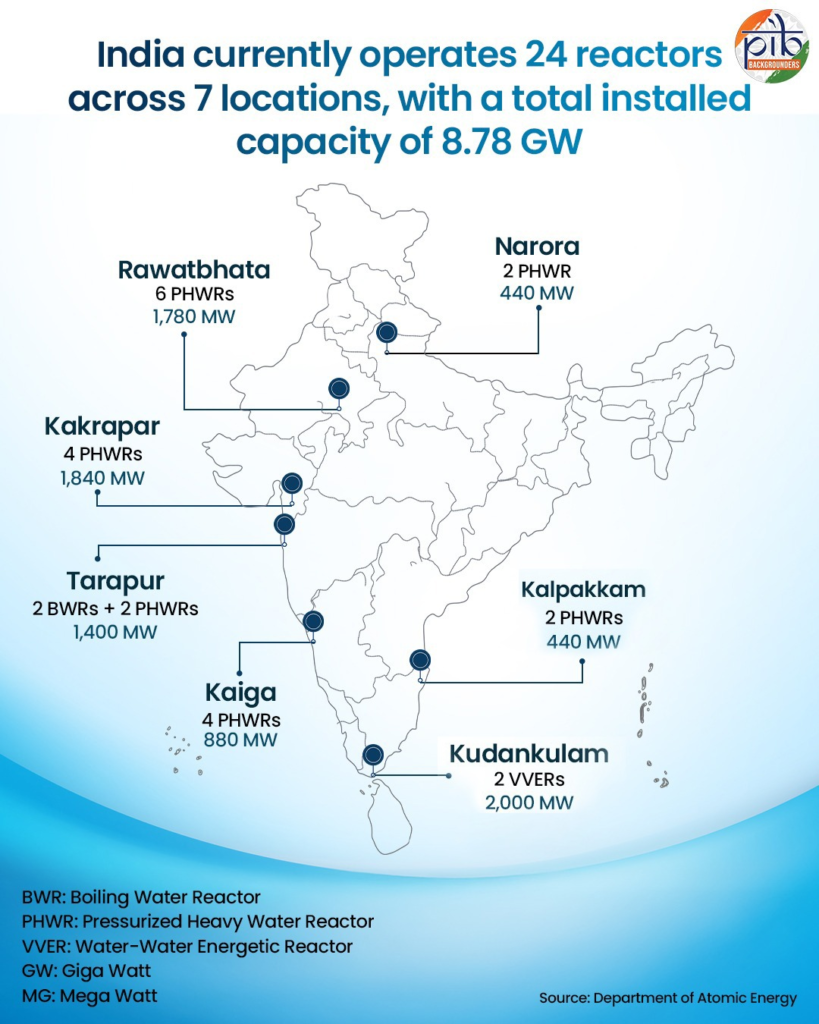
- The SHANTI Bill has raised concerns about accountability and public safety. Critics argue that removing supplier liability (faulty equipment or services) and capping operator penalties may weaken accountability in case of nuclear accidents. This could undermine the “polluter pays” principle and compromise public safety. Private firms may benefit financially, while the state and citizens bear the costs and risks of accidents. Given India’s experience with industrial disasters like the Bhopal Gas Tragedy, critics worry that weakening liability provisions may erode public trust in nuclear governance. Meanwhile, India aims to increase its nuclear power capacity from 8.18 GW to 100 GW by 2047, with plans to develop new technologies like Small Modular Reactors and advanced reactor designs.
- The lower house of India’s parliament however has passed the bill proposing a new legal framework for India’s nuclear sector and as a bill must be passed in an identical form by both houses of the Indian parliament, after which it will be presented to the President of India for assent. It was discussed in the Rajya Sabha before becoming a law by Minister of State ‘Jitendra Singh’ , who described it as “landmark legislation” for India.
- Rajya Sabha also clearing the Sustainable Harnessing and Advancement of Nuclear Energy for Transforming India (SHANTI) Bill on Thursday (18 December, 2025), the Union Government said the Bill seeks to reduce the dependency on fossil fuels and increase the capacity of India’s atomic energy sector. Senior Congress MP Jairam Ramesh, who initiated the debate, claimed that the Bill was brought with the intention of increasing the contribution of private companies in the nuclear sector. Mr. Ramesh warned the Centre against any relaxation in liability norms and cited the example of France, where all nuclear reactors are under the Government control. Minister of State for Department of Atomic Energy Jitendra Singh said that nuclear power is a reliable source of energy, unlike other renewable energy options. He said there will be no compromise with safety, and as the Atomic Energy Act prescribes, safety will be ensured first before starting power generation. Mr. Singh said there has been no report of any radiation-related hazards to the public from any Indian reactors.
- The Rajya Sabha at last on Thursday passed the Sustainable Harnessing and Advancement of Nuclear Energy for Transforming India (SHANTI) Bill, 2025 completing its parliamentary approval after it was earlier cleared by the Lok Sabha.