
By Dr. Vijay Garg
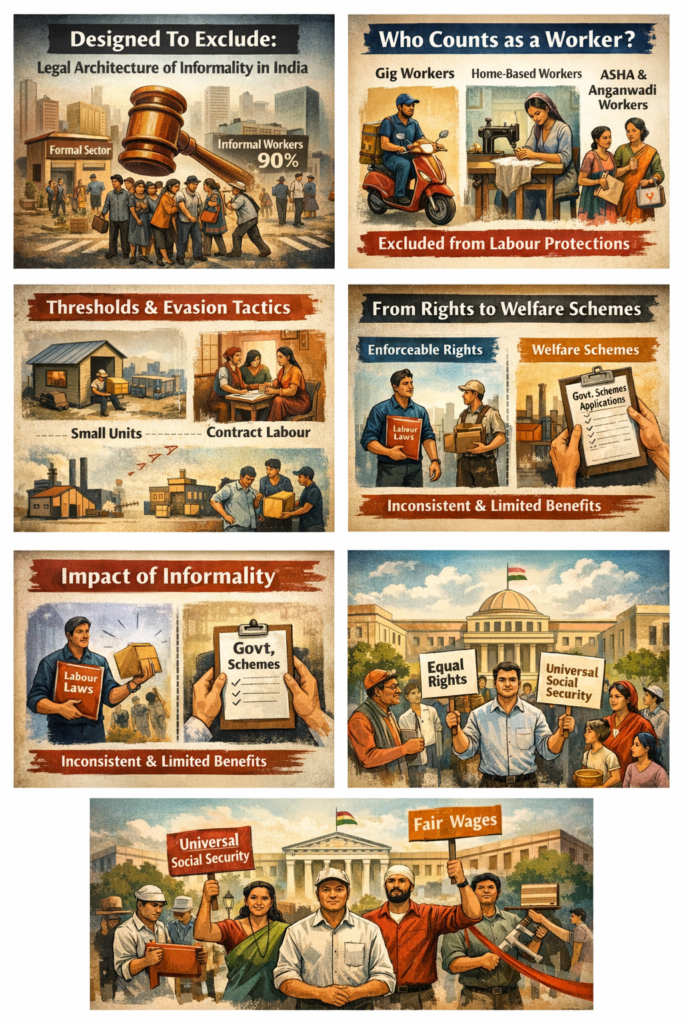
India’s labour market is often described as “informal,” with more than 90% of workers employed outside the organised sector. However, this informality is not merely the result of weak enforcement or economic backwardness. Rather, it is deeply shaped—and often produced—by the legal framework governing labour and employment. The structure of labour laws, definitions, and eligibility thresholds collectively create a system that excludes large segments of workers from legal protection and social security.
Informality: A Legal Construction
Formal employment in India typically refers to work performed in registered establishments where workers receive regular wages and enjoy enforceable rights and social security. Yet even within formal establishments, many workers remain contractual, casual, or outsourced, leaving them outside the protective framework of labour laws. Informality therefore exists not only outside the law but also within it.
Legal frameworks contribute to informality through three primary mechanisms:
- Narrow definitions of “worker” or “employee”
- Threshold-based applicability of labour laws
- Discretionary welfare schemes replacing enforceable rights
Together, these mechanisms produce informality as a legal status rather than a mere economic condition.
Who Counts as a Worker? The Politics of Definition
One of the most powerful tools of exclusion lies in legal definitions. Many categories of workers remain unrecognised because labour laws define “worker” narrowly.
For example:
- Home-based workers, piece-rate workers, and gig workers often lack legal recognition despite clear employer control over wages and working conditions.
- Women in informal industries and workers in household-based production may be labelled as “casual” or “self-employed,” denying them labour protections.
- Gig and platform workers are recognised as separate categories but placed outside traditional employer–employee relationships, limiting enforceable rights.
Similarly, frontline care workers such as ASHA and Anganwadi workers are often treated as “volunteers,” despite performing essential public services.
These exclusions are often justified under the rhetoric of “flexibility,” but in reality, this flexibility is rarely a choice for workers. The absence of legal recognition enables exploitative working conditions and allows employers to avoid obligations such as minimum wages, safety standards, and social security.
Thresholds and Employer Evasion
Another major source of exclusion lies in statutory thresholds. Many labour protections apply only to establishments exceeding a certain number of workers or meeting specific criteria.
Examples include:
- Safety and factory regulations historically applied only to units employing a minimum number of workers, excluding smaller establishments.
- Protection against layoffs and closures applies only to establishments above certain workforce thresholds, which have been increased under recent labour reforms.
- Social security laws often apply only to establishments employing a minimum number of workers.
These thresholds incentivise employers to:
- Keep establishments small
- Outsource work
- Rely on contract labour
- Fragment production
As a result, informality becomes economically rational and legally convenient.
From Rights to Welfare Schemes
Instead of guaranteeing enforceable rights, recent legal frameworks often provide scheme-based social security benefits that depend on registration and administrative discretion. This approach fragments worker protections and weakens accountability.
Unorganised workers, gig workers, and platform workers are often placed into welfare schemes rather than granted enforceable labour rights. This shifts protection from a rights-based framework to a welfare model that is inconsistent, discretionary, and difficult to access.
Implications for Inequality and Worker Welfare
The legal architecture of informality has profound consequences:
- Workers lack access to social security, health benefits, and injury compensation.
- Contractualisation weakens job security and bargaining power.
- Gender, caste, and class inequalities are reinforced through occupational segmentation.
- Employers face incentives to evade regulation rather than comply.
Informality thus becomes a structural feature of the economy rather than a temporary condition.
Reimagining Labour Law for Inclusion
If informality is legally produced, it can also be legally dismantled. Meaningful reform requires a shift from selective inclusion to universal labour protections. Key reforms could include:
- Expanding the definition of “worker” to include gig, home-based, and platform workers.
- Removing arbitrary thresholds that exclude small establishments.
- Establishing universal social security coverage.
- Strengthening enforcement and accountability mechanisms.
- Ensuring labour rights are enforceable rather than scheme-dependent.
Conclusion
Informality in India is not merely an economic reality—it is a legal construct shaped by definitions, thresholds, and policy choices. By selectively granting rights and protections, labour laws have inadvertently institutionalised exclusion. Addressing informality therefore requires reimagining labour law itself, ensuring that every worker—regardless of sector, status, or workplace size—enjoys dignity, security, and enforceable rights.
Only then can India move towards a truly inclusive and equitable world of work.
Dr. Vijay Garg
Retired Principal
Educational Columnist
Eminent Educationist
Street Kaur Chand, MHR
Malout, Punjab